 |
 |
 |
 |
 |
 |
 |
 |
 |
 |
 |
 |
 |
 |
 |
 |
 |
 |
 |
 |
 |
 |
 |
 |
 |
 |
 |
 |
 |

Friedreich's ataxia and I
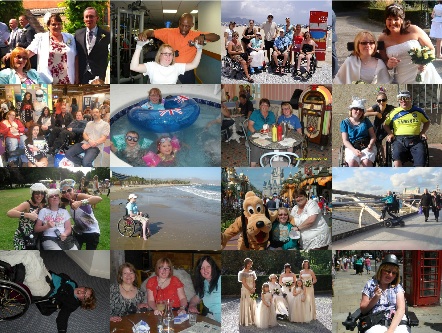 |
Hello, I'm Katie's sister Zoe and sadly I have to report that Matthew passed away on 11 April 2020. As you can see below, Matthew had very kindly offered to take over Katie's website last year as he felt very strongly that her legacy should continue and I am very grateful to Matthew's sister Louise, for allowing me to take over the reins. Both Matthew and Katie were such fantastic advocates for overcoming the challenges that living with Ataxia presents and had many an adventure together, particularly as they shared the same birthday. They were both also tremendous sources of support for fellow Ataxians and I hope this website will continue to do the same.
Hello everyone, my name is Matthew Law and I had been a friend of Katie’s since she was 19. Very sadly Katie passed away unexpectedly on the 13th January this year. Her death was completely unrelated to Friedreich’s ataxia. It is both my wish and that of her family that this website shall remain as it can be viewed as a legacy she has left in her passing. My tribute to Katie can be read here: My Tribute to Katie
I was diagnosed with Friedreich’s ataxia (FA) when I was 8. On this website you'll find information on FA and how it affects me.
I've had a website for over 20 years; some of the stuff on here has been there for years - its just been changed and updated many times. It's a great outlet for me and I love hearing from people who read it. My hope is that people who have just been diagnosed with ataxia read my website and see how I've had it for 27 years and lead a very fulfilled life which I'm very happy with. Subsequently I hope they come away thinking I CAN live with this!
Looking for a good place to start? Head to FA & I: Celebrating 27 years together.
What is FA?
In order to make the rest of your body move, your brain sends messages to it via nerve cells. Basically a message leaves the brain and then it is passed from one nerve cell to the next and so on until it reaches wherever it needs to go to.
But in my body the nerve cells that carry these messages progressively become damaged. I move in a very awkward and uncoordinated way because the messages become mixed-up. It's like your brain and the rest of your body being on two ends of a telephone conversation. Both parties are talking and listening as they should be, with the brain telling the body what to do and the body telling the brain that it has done it. But the telephone wire (which acts like the nerve cells carrying the messages) has become nicked and knotted and the conversation becomes jumbled up.
Why does this happen? Well FA is recessively inherited. You have two copies of every gene in your body: one from your mum and one from your dad. With something that's recessive, be it FA or red hair, you need both copies of the gene to carry it. If only one copy carries it but the other doesn't, then the copy that doesn't carry it will dominate. In my body both copies of the gene carry FA - there is no 'good' copy to override the bad FA one.
The bad copy has a mistake in its DNA and my body is instructed to make too little of a protein called Frataxin. Frataxin regulates the amount of iron in cells, and not having enough of it means that iron builds up in the cell. The build up of iron causes damage to the cells. The cells mostly affected are nerve cells, but cells in the pancreas and heart can be affected too, causing Diabetes and Cardiomyopathy, and also cells within bone tissue which causes Scoliosis (curvature of the spine) and feet deformities.
FA is pretty rare - 1 in 40,000 in the UK (that means there are about 1,500 people who have FA in this country). I don't really like having something that nobody knows about, hence this website and if you happen to meet me in person then please know that I'm more than happy to talk about it - in fact I appreciate it when people take an interest and it makes me feel that I'm raising awareness in a small way.